Buying from a box plant or a supplier
A box plant makes corrugated board or converts it into boxes; a box supplier sources boxes from plants and sells them to the people who use them. We are a supplier. We do not run a plant; we quote new boxes made by plants to your specification and deliver them to your ZIP.
How boxes are made
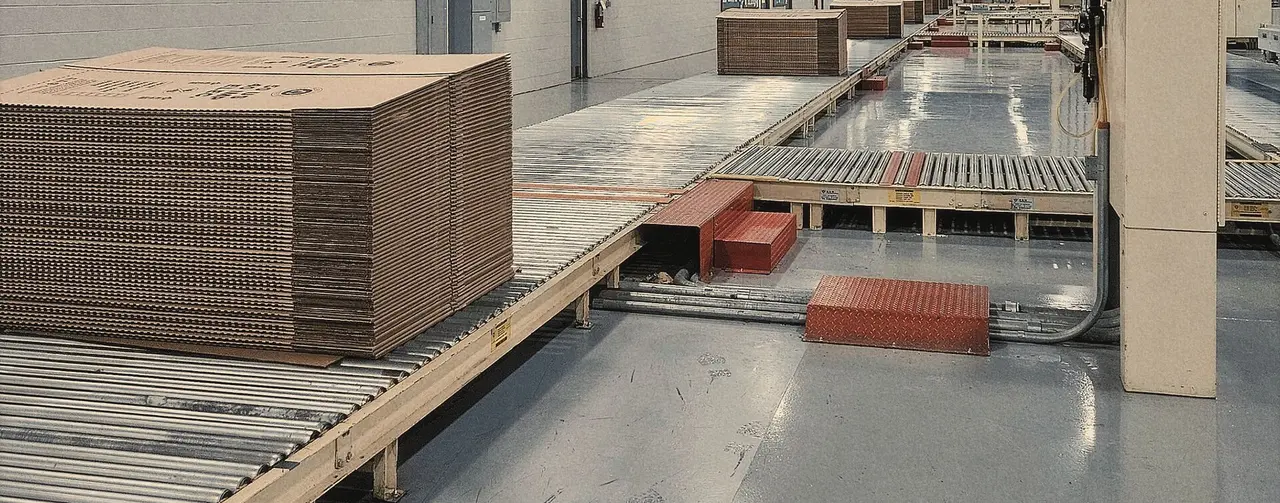
Most corrugated boxes start on a corrugator, a long machine that heats and flutes a paper medium and glues it to liners to make sheets of board. Large integrated plants run corrugators and also cut, crease, print and glue the sheets into boxes. Smaller sheet plants buy board from a corrugator and convert it. Both kinds are "box manufacturers" to someone searching for one.1
The industry is large and its output moves with the economy: Packaging Dive, citing Fibre Box Association data, reported US corrugated box shipments down 1.6% from a year earlier in the third quarter of 2026.2
Buying from a plant
A plant sells directly when the order is large and steady enough to schedule: full truckloads of a few sizes on a regular cycle. In return you deal with the people who run the machines, and for very large volumes the price reflects that. For a buyer with smaller or mixed orders, the plant may not be set up to quote, or may send you to a distributor.
Buying from a supplier
A supplier works across plants. That means a range of styles and grades from one place, mixed sizes on one delivery, smaller runs, and someone who will tell you which plant is best placed for your ZIP and your board. Catalogue suppliers hold stock sizes in warehouses; others, like us, quote each order to specification. Both buy the board from the same industry.
How we quote
Send the inside size, style, grade, count and ZIP. We quote new boxes made to that specification, with freight, and say what we need confirmed before an order. We do not quote used boxes, and we do not claim a plant, a fleet or a stock count we do not have. If a stock size will do, we say so.
Which is right for you
If you buy full trucks of two or three sizes every week, talk to plants as well as suppliers. If you buy a few pallets a month, a range of sizes, or custom sizes in modest runs, a supplier is usually the simpler route.
Red flags
Prices far below everyone else, vague answers about grade, refusal to state a certificate rating, no written quote, pressure to pay upfront for an untested custom size, and photographs of somebody else's factory presented as their own, or an address that turns out to be a mailbox. Any of those should make a buyer pause and ask more.
What a good supplier does
Answers quickly, asks the right questions about weight and handling, explains the trade-offs between grades, quotes delivered prices with clear tolerances, ships on the agreed date and sorts out damage without argument. Those habits matter more than size or ownership. Ask for references from buyers like you, check how complaints were handled, and start with a modest order before committing a whole year's volume.
Lead times, minimums and stock
Plants schedule runs by machine and board grade, so a custom order joins a queue. Distributors with warehouses can ship stock sizes quickly but only in what they hold. Suppliers who quote to order sit between: they find a plant with capacity and the right board, which is often quicker than approaching plants one by one. Minimum runs vary widely from plant to plant and from one style to another; die-cuts with new tooling generally need more than plain RSCs.
None of these figures can honestly be stated in advance for every order. Anyone who promises a fixed lead time or minimum before knowing the size, board and count is guessing. Our quotes give them once the specification is clear.
Local or national
Because flat boxes are bulky for their weight, freight is a larger share of their cost than for many products. That is why plants tend to serve customers within a few hundred miles. A supplier who sources across many plants can usually find one well placed for your ZIP, which keeps freight sensible wherever you are.
That is also why we quote delivered prices: the box and the trip are one cost to you.
Integrated mills, sheet plants and distributors
At one end of the industry are integrated companies that own paper mills, corrugators and converting plants. In the middle are independent corrugator plants and sheet plants that buy board and convert it. At the other end are distributors and suppliers who buy finished boxes and sell them on, some with warehouses of stock, some quoting to order. Each part has its strengths, and a box might pass through several of them before reaching you.
For a buyer, the practical differences are order size, the range of styles, the speed of a quote, and who solves a problem when a load arrives damaged. Ask any source how it handles those, and judge on the answers.
Questions to ask any source
Whoever you buy from, ask what grade and style you will get, what the certificate will say, how the boxes will be bundled and palletized, how freight is charged, and what tolerance applies to the count. Ask whether the size is a stock item or made to order. Those answers matter more than whether the seller owns a corrugator.
Why buyers search for a manufacturer
People often search for a "box manufacturer" when they mean any company that can supply boxes to their size. That is reasonable: a custom box is manufactured for the order, wherever it is bought. What matters is getting the right box, at a fair delivered price, reliably. We are clear that we are a supplier, and quote on that basis.