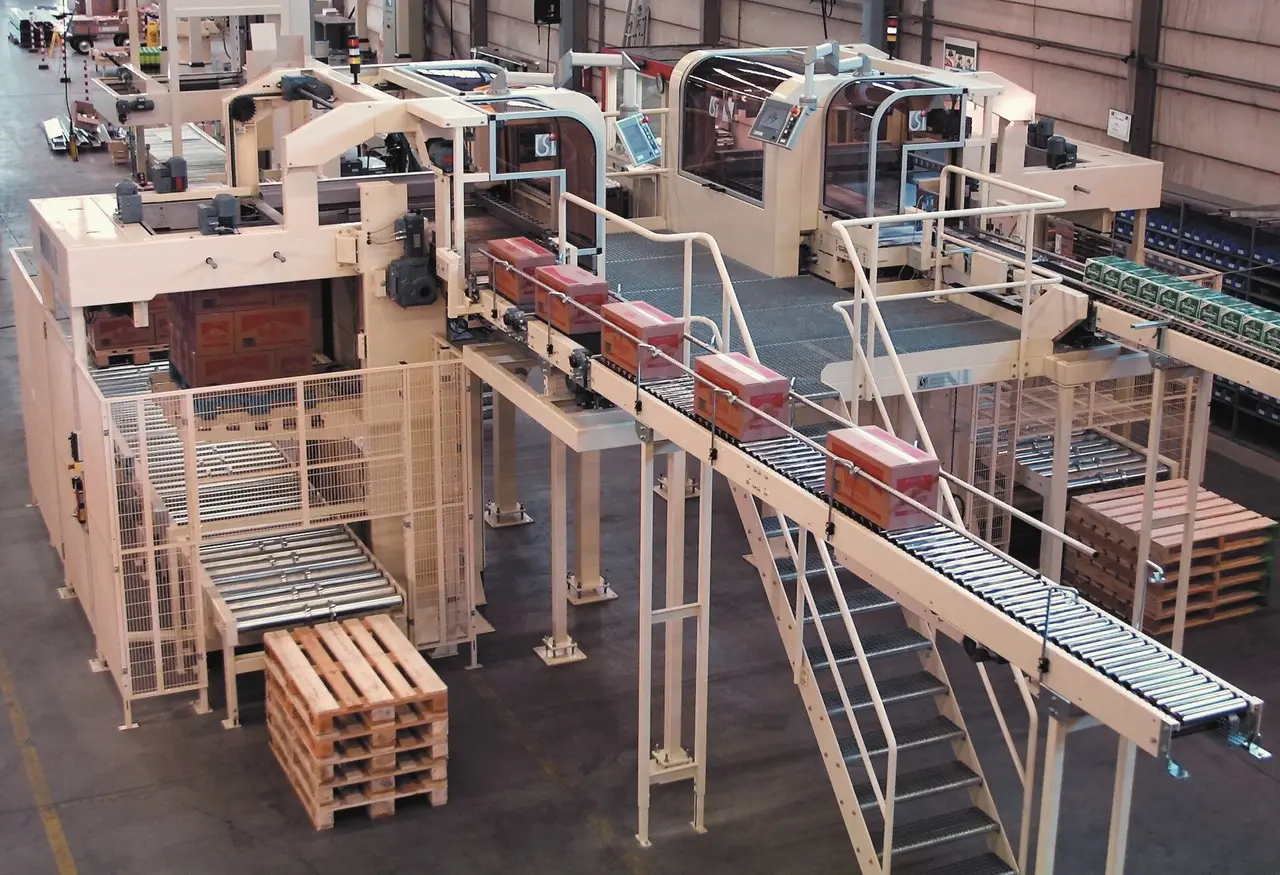
Corrugated boxes for food and beverage packers
Food and beverage plants buy shipping cases in volume, a few sizes in a fixed grade, delivered by the pallet to keep the packing line running. They ask for an exact inside size because the case has to fit the product and the palletizer pattern.
What gets packed, and how it travels
Cans and bottles in 12- and 24-count cases, jars in partitioned cases, bagged snacks in light RSCs, bulk ingredients in pallet-size boxes. Private employers in US food manufacturing averaged 1,775,008 jobs in 2025, and beverage manufacturing another 316,938; California, Texas and Illinois lead food manufacturing by jobs.
Cases leave the plant on pallets, often stacked six or more layers high, and sit in distribution centres before reaching a store. Stacking strength is the property that matters most.
Where the wrong box goes wrong
A case that is a quarter inch too big lets bottles move and labels scuff, and a palletizer pattern built for one footprint will not take another. A case that is undersized for its stacking load bows at the bottom of the pallet in a humid warehouse. For heavy liquids, check the packed weight against the board rating before anything else.
Working with a packing line
Case erectors, packers, sealers and palletizers all depend on cases being made the same way every time. When a plant changes supplier, the first runs are often trialled on the line before a full order. If yours is an automated line, include the equipment, the case style, the board spec from the certificate and any print or barcode position; we quote to all of it so the case runs as before.
Retail-ready packaging, cases that open into a shelf display, is common for snacks, canned goods and beverages. It needs perforations, print and a design that still stacks well on a pallet. Many retailers publish requirements for such cases. Send them along with your product dimensions.
Questions buyers ask
- Do you quote cases to fit our palletizer pattern?
- Yes. Send the inside dimensions you need and the pallet pattern, and say whether the outside size is fixed. We quote the case to suit.
- Can food boxes carry lot codes?
- Lot codes and dates are usually printed or labelled on your line. FDA's food traceability rule asks firms handling listed foods to keep traceability records; the box is where many put the code.
- What about wet or cold storage?
- Moisture weakens corrugated board. Tell us when cases will sit in cold or wet rooms; see our page for frozen and refrigerated food.
Boxes for food and beverage: ask for a price
Give each size you use with its grade and count, and the ZIP it goes to. Several sizes can go on one request.
- Inside size
- length x width x depth, in inches
- Style
- RSC, full overlap, telescope, die-cut or bulk
- Wall and grade
- read it off the stamp on your current box
- Count
- boxes per order, and how often you reorder
- Packed weight
- box plus contents
- ZIP
- where the boxes are delivered
After you send it
- We reply by email, usually with questions first if anything is unclear
- You confirm the specification, and a sample or drawing if it is a new design
- We send the price, the delivery window and the count tolerance
- On approval the order is scheduled and shipped to your dock