What a corrugated box is
A corrugated box is a box made of corrugated board: a fluted paper sheet glued between flat paper liners, which together are far stiffer than the same paper laid flat. Most people call it cardboard; the trade calls it corrugated, and keeps "cardboard" for thin, solid paperboard such as a cereal carton.1
The parts of the board
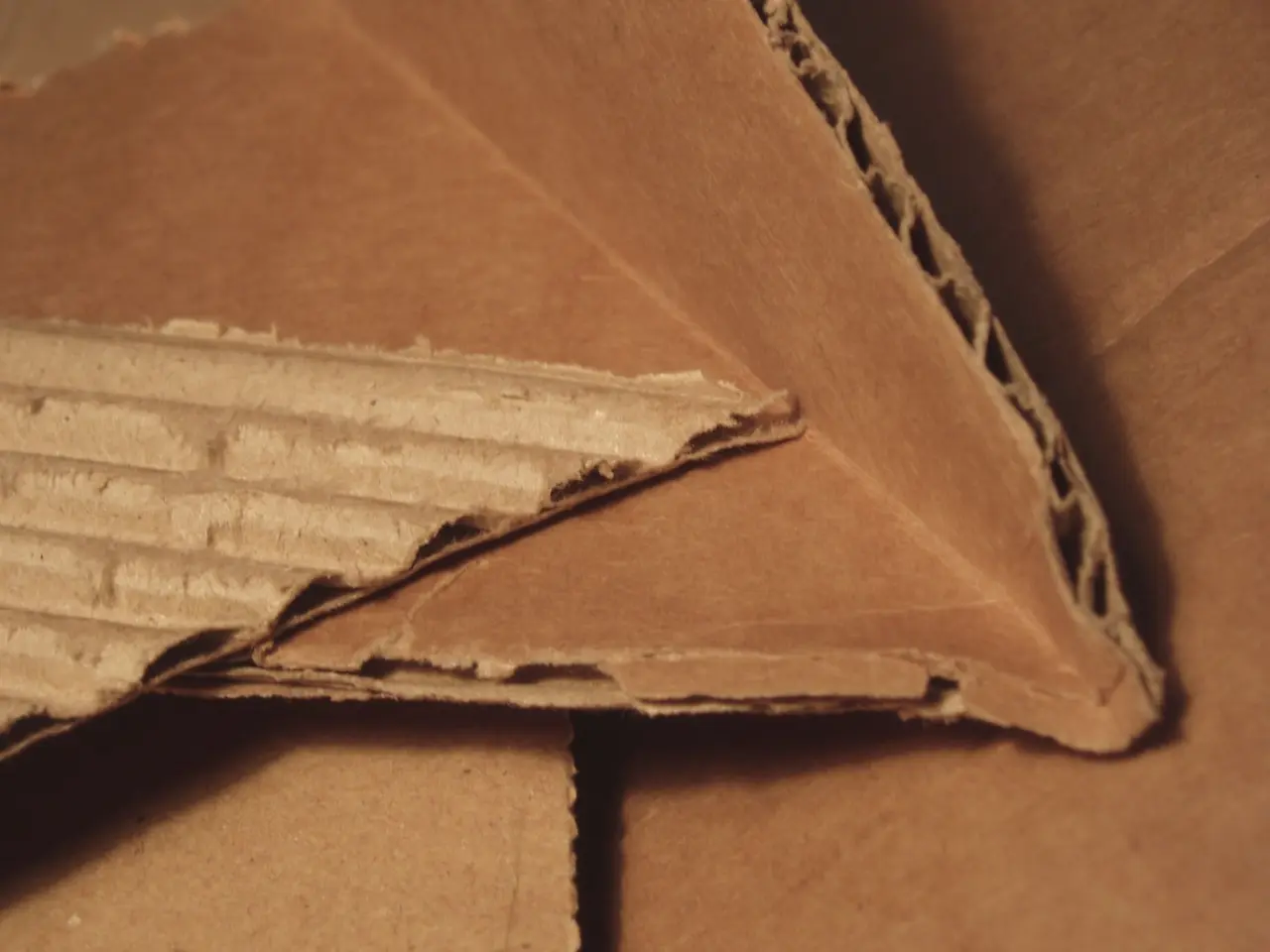
The flat outer sheets are linerboard. The wavy sheet between them is the medium, and its waves are the flutes. Glued together, the arches of the flutes act like a row of small columns between two plates, so the board resists being bent and crushed far better than its weight suggests.
Single wall board has one medium and two liners. Double wall has two media and three liners. Triple wall has three media and four liners, seven layers of paper.2 Flutes come in standard sizes named by letter, A, B, C, E and F, which differ in height and spacing.1
How it is made
On a corrugator, the medium is steamed and pressed between toothed rolls that form the flutes, starch glue is applied to the tips, and a liner is pressed on. A second liner closes the other side. The board is cut into sheets, which are then scored, slotted, printed and folded into boxes, and the box's joint is glued, stitched or taped.
Why boxes are corrugated
Corrugated board is light, cheap for its strength, ships flat, prints well and is easy to cut into almost any shape. It cushions, it stacks, and it can be rated to a published standard. It is also widely recycled.
AF&PA put the 2023 US recycling rate for old corrugated containers at 71 to 76 percent under its new method, against 93.6 percent for 2022 under the old one.3 The two figures are not directly comparable because the method changed.
Corrugated or cardboard
When someone asks for "cardboard boxes" for shipping, they almost always mean corrugated. Solid paperboard, sometimes called chipboard or folding carton, is what retail packaging is made from: a cereal box, a shoe box. It is thin and prints beautifully, but it is not a shipping box. Everything we quote is corrugated.
Further reading
The guides on flutes and on ECT go deeper into strength.
Sizes of the industry
Corrugated is among the largest uses of paper in the United States. Thousands of converting plants, from giant integrated mills to small sheet plants, make boxes for nearly every product that moves. Trade associations track shipments quarterly as a signal of the wider economy, because almost everything bought travels in a box at some point.
Common misconceptions
Brown does not mean recycled and white does not mean virgin: colour comes from the liner, which may be bleached, unbleached or coated. Thicker is not always stronger: a well-made single wall in good paper can outperform a poorly made double wall. And corrugated is not waterproof; coatings help, but board left in rain or standing water will weaken quickly.
Strength for weight
Corrugated board works like an engineering sandwich: two stiff faces separated by a light core. The farther apart the faces, the stiffer the panel, which is why taller flutes and double wall board stack better. Aircraft floors and honeycomb doors use the same principle with other materials.
Words the trade uses
Containerboard is the paper grade used to make corrugated: linerboard for the facings and corrugating medium for the flutes. Kraft linerboard is made mainly from virgin wood fibre and is strong and brown; testliner and recycled liners use recovered fibre. White-top liner has a bleached surface layer for printing. A knocked-down box, or KD, is one shipped flat. A blank is the flat cut sheet before it is folded. A score is a crease that guides a fold, and a slot is the cut that separates the flaps.
You will also hear boxes called cases, cartons and shippers. In the trade they all mean the same thing: a corrugated container used to ship goods.
A short history
Pleated paper was first patented in England in the 1850s as a lining for tall hats. In the 1870s an American patent added a liner to one side to make a cushioning wrap for bottles and glass, and soon after a second liner gave the board we know. By the early twentieth century, corrugated boxes were replacing wooden crates for shipping, and by mid-century they were the standard.
Where corrugated goes next
Used boxes are baled at stores and warehouses and sold as old corrugated containers to paper mills, which pulp them and make new linerboard and medium. Much of the board in a new box has been through that cycle before. Keeping boxes dry and clean before recycling makes them worth more.