How to measure a box
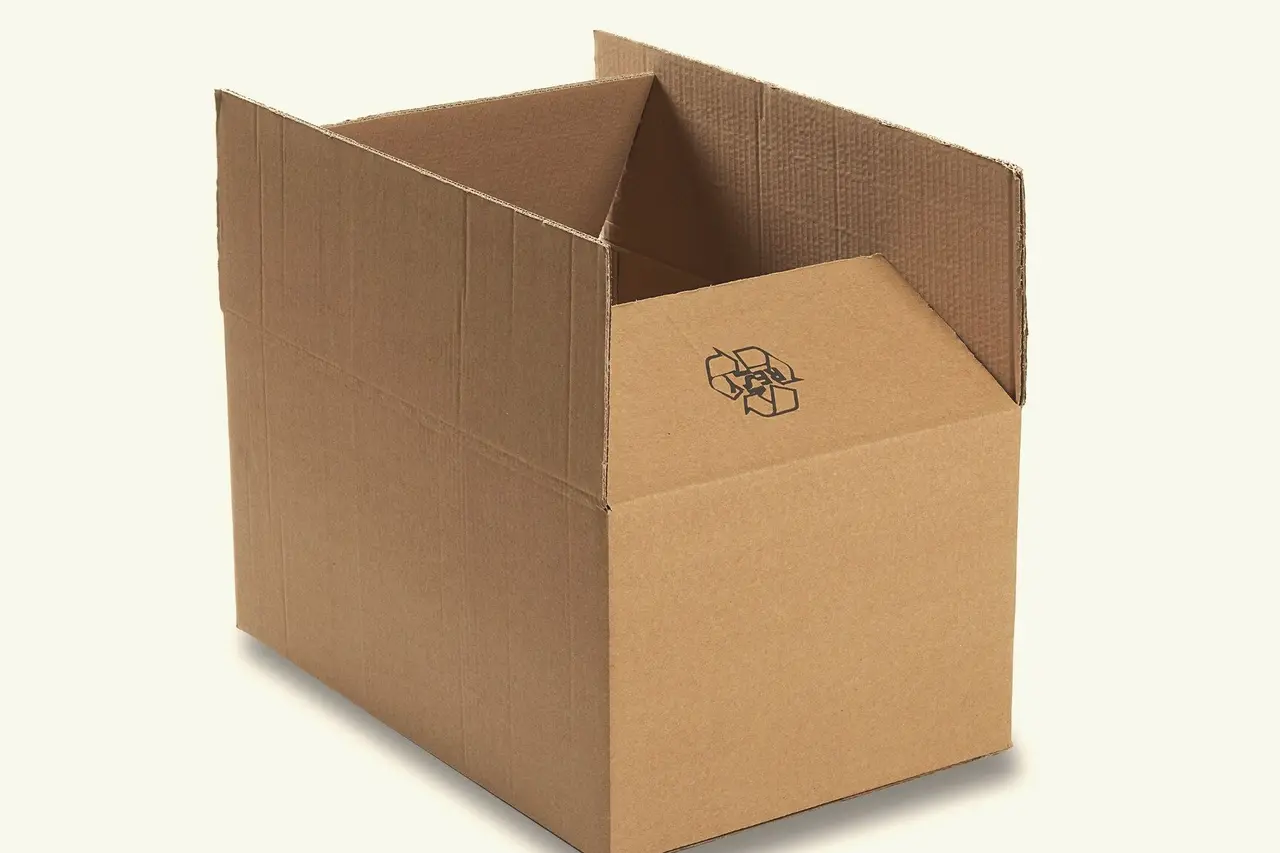
Measure a box on the inside, at the opening: length is the longer side of the opening, width the shorter side, and depth runs from the opening down to the floor. Write it as L x W x D, in inches, in that order.12
Why inside, and why that order
Boxes are specified and ordered by their inside dimensions because the inside is what has to hold the product.1 The outside depends on the board: a double wall carton is thicker than a single wall one, so two boxes with the same inside size can have different outside sizes. A supplier quoting from an outside measurement has to guess the board, and the guess is often wrong by a quarter inch or more.
The order matters as much. A 12 x 10 x 8 box and a 12 x 8 x 10 box hold the same volume but are different boxes: the first opens on a 12 by 10 face and is 8 deep; the second opens on a 12 by 8 face and is 10 deep. Flaps are cut from the length and width, so the order changes how the box closes and how it stands on a pallet.
Measuring a box you already use
Open the box flat on its base with the flaps upright. Run a tape across the inside of the opening from wall to wall along the longer side, then the shorter side, then down inside a corner from the top of the wall (not the flap) to the floor. Read to the nearest eighth of an inch.
If the box is crushed or bowed, measure two or three places and take the largest. If you only have a flat, knocked-down box, measure between the score lines on the panels; the panel widths give length and width, and the height between the flap scores gives depth.
Measuring a product for a new box
Measure the product at its widest points, then add whatever protects it. An inch of foam or air pillows on every side adds two inches to each dimension. A product that ships in a retail carton inside a shipping box needs the retail carton measured, not the product. Round up to the next eighth or quarter inch; a box that is a fraction too small is useless, and one a fraction too big costs very little.
Common mistakes
Measuring outside is the first. The second is putting depth first because the box is tall. The third is forgetting the flaps fold inward on some die-cut styles and take up room. The fourth is measuring a sample box that has already been stretched by use; a new box of the same size will be tighter.
How it goes on a quote
On a purchase order a box reads as size, style, board and count: for example, 12 x 10 x 8 RSC, 32 ECT, 500. Our quote form asks for the same things in that order, plus the packed weight and your ZIP. If you are not sure of the style or the board, say so and describe what goes in the box.
Special cases
Telescope boxes are measured on the base: give the inside of the bottom piece, and say how deep the lid should reach. Mailers and other die-cuts have tuck flaps and dust flaps that intrude inside, so give the space the product needs and let the designer allow for them. Tubes and triangular boxes are measured by their inside diameter or the inside length of a side. For a bulk box, give the inside footprint and depth, and the pallet it will sit on.
For odd shapes, such as a lamp, a curved part or a bundle of rods, measure the smallest rectangle that encloses the product, then add padding. A photograph with a tape measure in frame helps whoever quotes the box understand what it must hold.
Inside, outside and carrier dimensions
Carriers measure the outside of a parcel to work out dimensional weight, and pallet planners use the outside size to fit a pattern. So while you order by the inside size, you will often need the outside too. A rough allowance is about a quarter inch on each dimension for single wall, and about half an inch for double wall. Ask for the exact figure if a few millimetres matter.
A few sizes for many products
Shippers with dozens of products rarely need dozens of boxes. List each product with its padded size, sort the list by volume and look for groups whose sizes sit within an inch or so of each other. One box per group, sized to the largest item in it, usually covers the range with a handful of sizes. A small gap is taken up with a little more fill; a big one means another size, because a small item in a large carton pays dimensional weight on every parcel and is free to move.
Boxes with partitions or inserts
If the box takes dividers or a foam insert, measure the product for its cell, not for the box. Give the cell size, how many cells across and how many deep, and whether the dividers run the full depth. The box is then sized around the partition set, which adds the thickness of a divider at every wall, roughly an eighth of an inch each in single wall board. Glass bottles, jars, candles and small machined parts are the usual reasons to want one.
Checking the size against the pallet
If the boxes leave on pallets, check the outside size against a 48 x 40 pallet before settling the inside size. Boxes load best when their length and width divide into 48 and 40 with little left over, and one inch on the inside can turn four boxes across into three. Each size page on this site draws the layer pattern for its box.
Worked example
Say you ship a boxed blender that measures 9 1/4 in long, 7 3/4 in wide and 15 in tall, and you want an inch of padding all round. Add two inches to each: 11 1/4 x 9 3/4 x 17. The box opens on the long, flat face, so length is 11 1/4, width 9 3/4, depth 17. Round up to the nearest quarter inch and you have it. If a stock size of 12 x 10 x 18 is close enough, it may be quicker to source.